


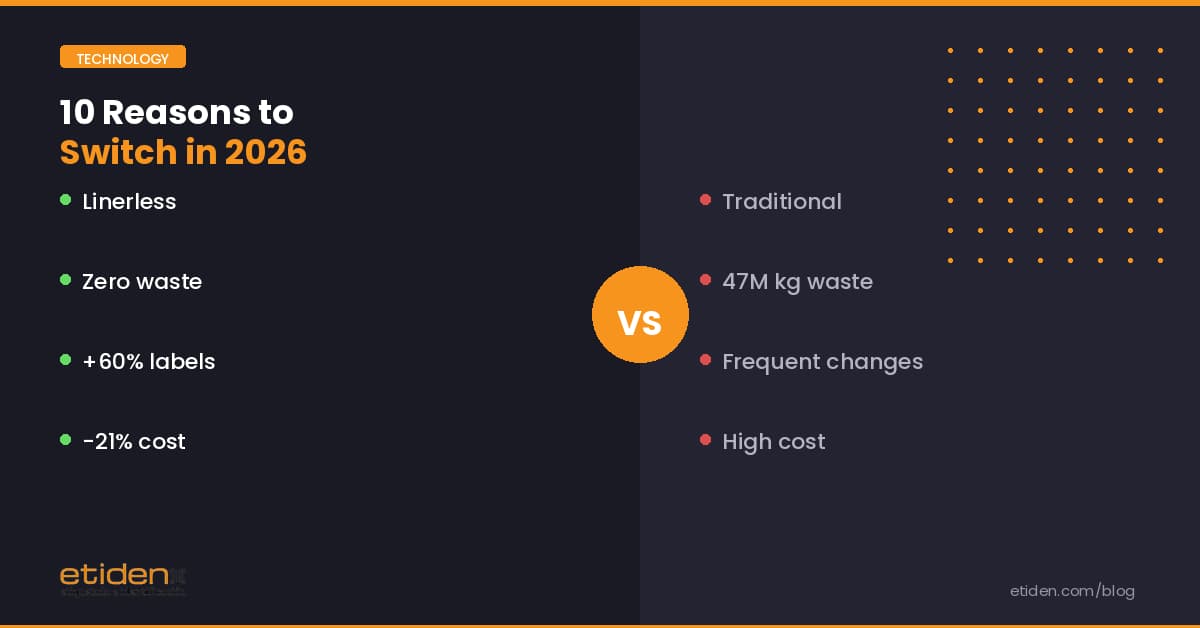
Linerless vs. Traditional Labels: 10 Reasons to Switch in 2026
If your company prints adhesive labels daily, there is something you have probably never considered: every label you apply generates silicone-coated liner waste that goes straight to the landfill. It is not recycled. It is not reused. It is only discarded.
Linerless technology eliminates this liner completely. And the benefits go far beyond sustainability. These are the 10 reasons why more and more companies are making the switch in 2026:
1. Up to 60% more labels per roll
Without the liner taking up space, many more labels fit on each roll. This translates into fewer roll changes, fewer downtimes, and higher productivity. In high-volume operations, the difference is massive.
2. Zero liner waste
It is estimated that 370,000 tons of silicone liner end up in landfills every year in the United States alone. With Linerless, that waste completely disappears. Your company eliminates an entire waste stream overnight.
3. Faster process: 2-step Print & Paste
Conventional labeling requires three steps: peel, paste, and discard the liner. With linerless, you only need two: print and paste. This saves 2-3 seconds per label, which in volume turns into hours recovered every week.
4. Variable length labels
With a conventional roll, you are limited to the die size. With linerless, the printer cuts the label to the exact length you need. One roll, infinite possibilities.
5. 35% reduction in carbon footprint
Life cycle analysis studies show that linerless labels reduce the carbon footprint by 35% compared to conventional ones. They also consume 33% less water during manufacturing.
6. Up to 21% savings in Total Cost of Ownership (TCO)
Less material, less transportation and storage, and greater operational efficiency result in significant savings in the total cost of the labeling process.